01The room
One buyer. One space. Everything that matters to them.
A digital sales room (DSR) is a private online space shared between a seller and a buyer. Gartner describes them as spaces "privately formed for a vendor and a customer to collaborate digitally" [1]. Instead of a deal living across a dozen emails, attachments and calendar invites, it lives in one place the buyer can come back to and share with colleagues.
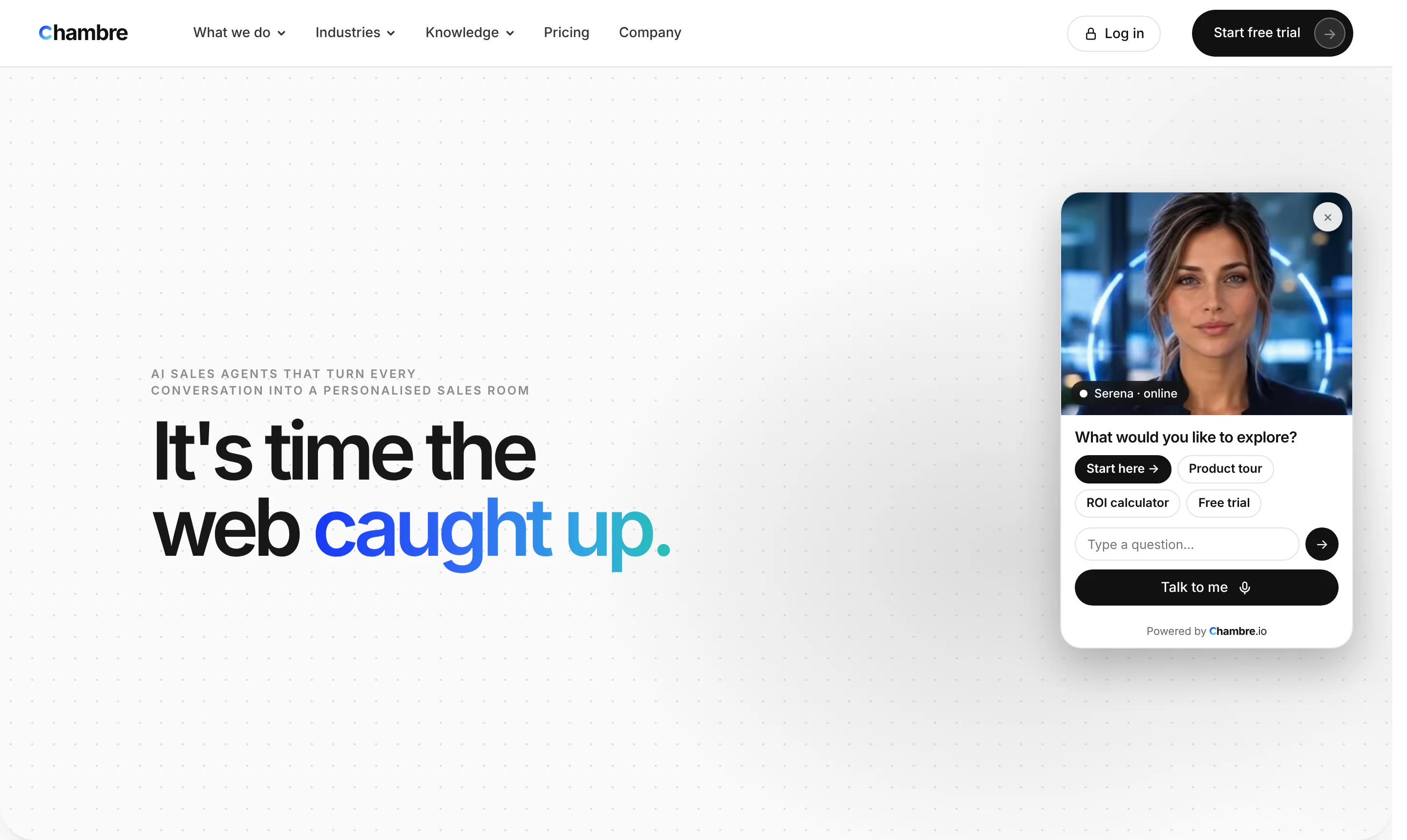
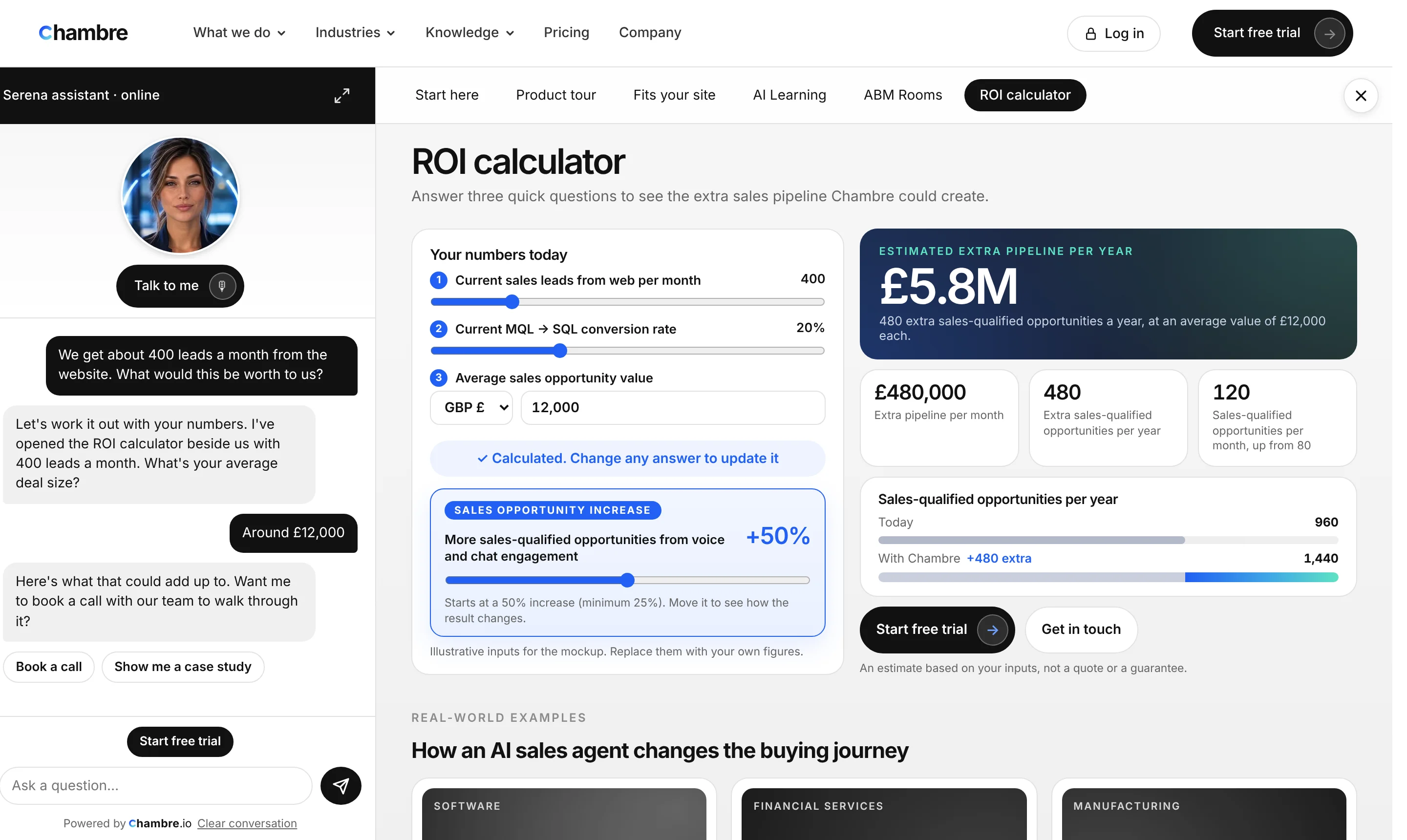 VisitorWe get about 400 leads a month. What would this be worth to us?
Serena · AI sales agentLet's work it out with your numbers. What's your average deal size?
VisitorAround £12,000.
The AI sales agent talks with your visitor
Generating a room from the conversation…
✓The room takes over the website: an immersive space for one buyer
Keep scrolling to watch the room build. Sample figures for illustration.
Content
The product tour, case studies and documents that fit this buyer, not the whole library.
Numbers
Pricing, ROI and the business case, in their figures.
People
Every stakeholder in the buying group, seeing the same story.
Next steps
What happens next and who does what, agreed in one place.
B2B buying is done by groups, mostly online, often without a salesperson in the room. A sales room gives the group one place to decide.
02The shift
From a page someone builds to a room that builds itself.
The first digital sales rooms were built by hand. A salesperson assembled a microsite for a deal that was already in progress, usually after a few calls. That works for late-stage opportunities, but it means most buyers never see one: the visitor researching on your website at night gets the same pages as everyone else.
The traditional sales room
- Built by a seller, for deals already in the pipeline
- Created after discovery calls
- Static until someone updates it
- One room per opportunity, as time allows
The AI-generated sales room
- Opens for any visitor, from the first conversation
- Shaped by what the buyer says, as they say it
- Changes as the conversation moves
- A room for every visitor, at once
With an AI sales agent, the room is staged live. A visitor says they run a forty-person sales team and care about HubSpot. The agent answers, then opens the integration overview beside the conversation. Asked about cost, it opens the ROI calculator with their team size filled in. Ready to talk, it books the meeting and the room's contents go to your team with the transcript.
of B2B buyers say they prefer a buying experience without a sales rep.
Gartner survey of ~650 B2B buyers, 2026 [2]of B2B buyers will prefer sales experiences that put human interaction first, Gartner predicts, by 2030.
Gartner prediction, 2025 [3]Those two findings sound opposed, but they describe the same buyer: one who wants to explore on their own terms and still feel looked after. A room that builds itself around the buyer, with a person a click away, serves both.
03When to use one
Three moments a room earns its place.
A visitor is researching
They arrive with questions. The room opens beside the conversation and fills with what fits: the tour, the proof, the price.
You're opening a target account
Prepare a private room for the account before the first meeting, with an agent briefed on their business, and see who engages.
A buying group is deciding
Give every stakeholder the same content, numbers and next steps, so the case for buying travels well inside their company.
A website talks to everyone. A sales room talks to one buyer.
Give every visitor their own room.
Chambre's AI agent builds a digital sales room beside every conversation, from your own content, and books the meeting when the buyer is ready. Try it free for 7 days.
?Questions
Digital sales rooms, answered
What is a digital sales room?
A digital sales room is a private online space for one buyer, holding the content, proof, pricing and next steps that matter to them. Instead of a trail of emails and attachments, everything about the deal lives in one place the buyer can return to and share with colleagues.
How is a digital sales room different from a website?
A website speaks to everyone at once. A digital sales room is built around one buyer or account: their questions, their numbers, their stakeholders and their next steps.
What is an AI-generated digital sales room?
It is a sales room that builds itself during the conversation. As the buyer explains what they need, the AI agent opens the most relevant tour, case study, calculator or presentation beside the chat, so each visitor sees a room shaped by what they said.
When should I use a digital sales room?
Whenever a buyer needs more than one page to decide: complex products, several stakeholders, a business case to build or a longer sales cycle. For named target accounts, a prepared room (an ABM room) is a strong way to open the conversation.
Do buyers need to log in to a digital sales room?
Not with Chambre. A website visitor's room opens beside the conversation with no login. ABM rooms for target accounts are private pages shared by link.
- Gartner, "Innovation Insight for Digital Sales Rooms to Support Virtual Selling and Customer Experience", 17 January 2022, as quoted by Pitcher.
- Gartner survey of nearly 650 B2B buyers, reported March 2026: Gartner: 67% of B2B buyers prefer a rep-free experience (Demand Gen Report).
- Gartner: by 2030, 75% of B2B buyers will prefer sales experiences that prioritise human interaction over AI, August 2025.
Questions people ask
Keep reading